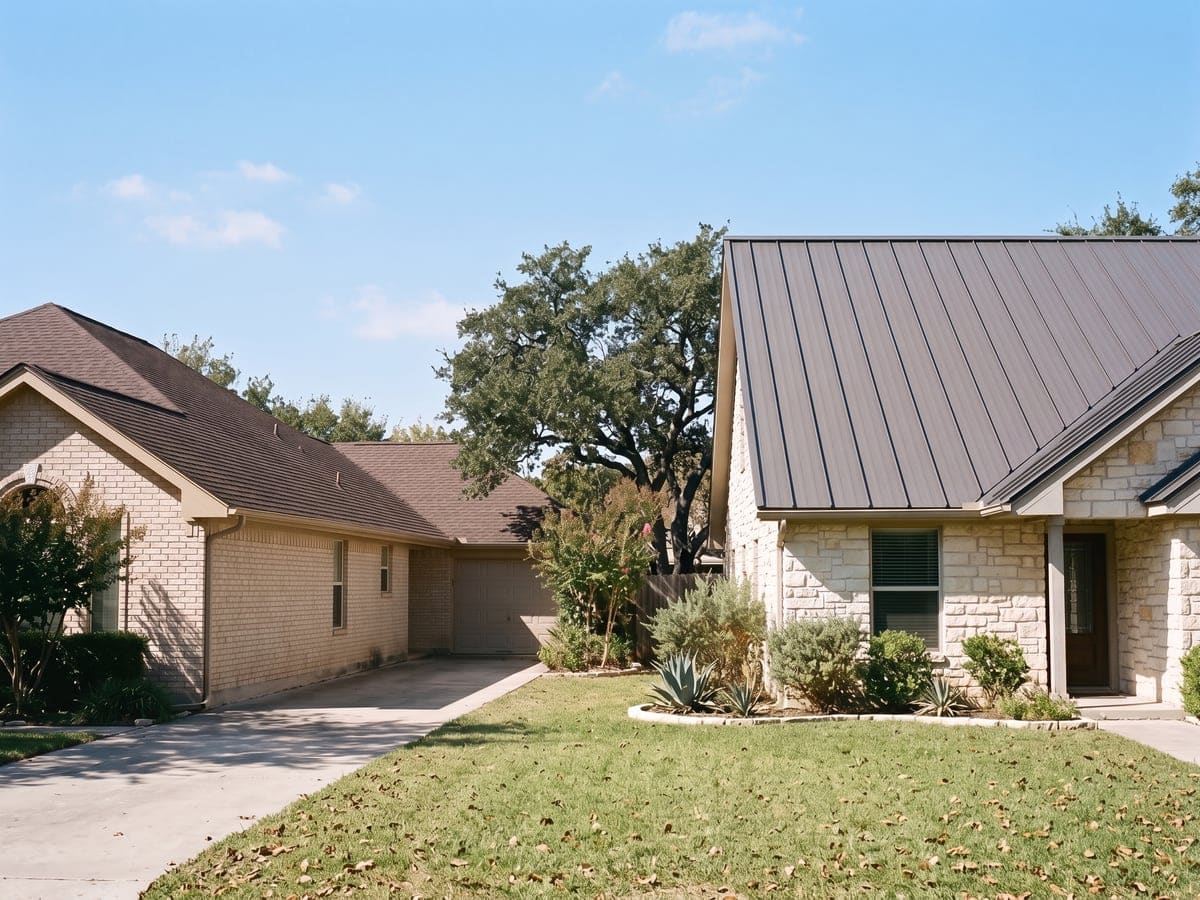
Asphalt shingles: the U.S. baseline
ARMA, the shingle makers' association, calls asphalt shingles the most popular choice for residential roof coverings in North America. They sit at about 80 percent of installed residential roofs in the U.S. and are frequently damaged in hail and high-wind events, per the research group IBHS.
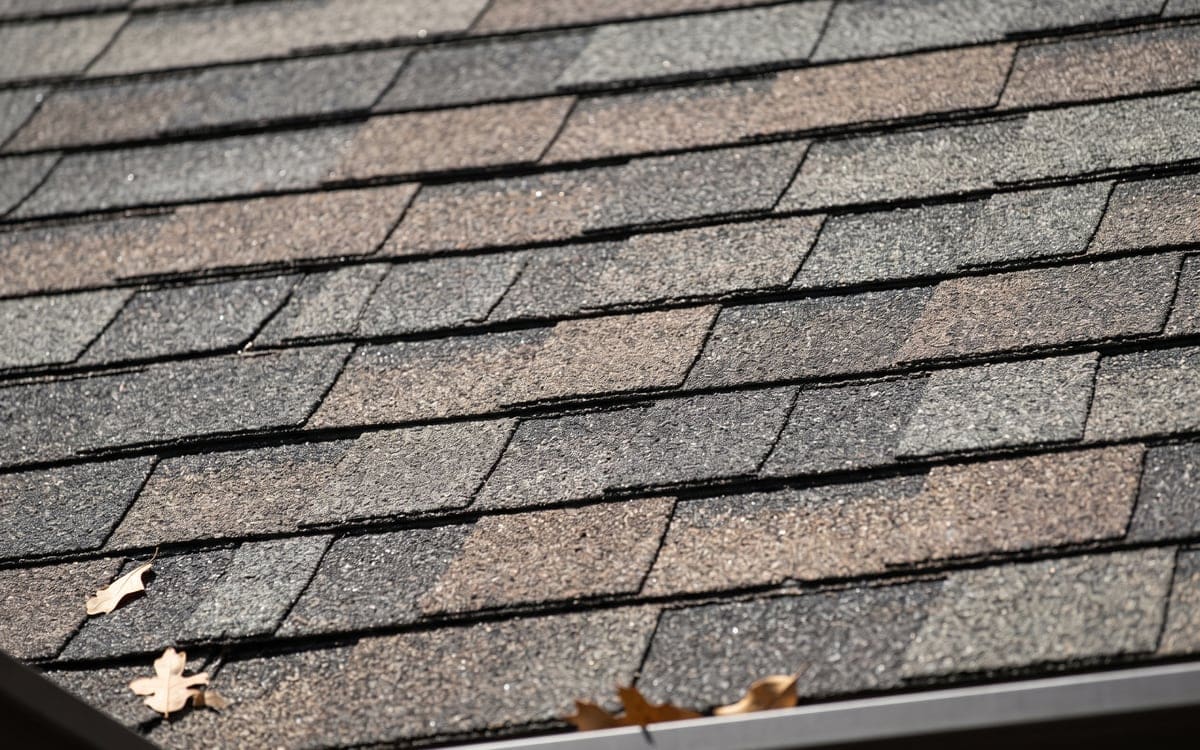
For types, laminated (also "architectural" or "dimensional") shingles are the most common type, and 3-tab is the basic single-layer type with cut-outs that form three tabs in ARMA's description. A metal roof goes on a different way.
How each one goes on
A shingle roof is nailed in overlapping horizontal courses from the eave up: starter at the eave, courses lapped so each one covers the nails of the one below, metal flashing at walls, valleys and penetrations, and a ridge or hip cap at the top. The underlayment and the drip edge go on first; the shingles tie into them.
Shingles and metal side by side
What the shingle makers and the metal roofing groups say about each.
Asphalt shingles
- The most popular residential covering in North America, ARMA says
- Laminated shingles are the most common type
- Impact ratings run from Class 1 to Class 4
Metal
- Most metal roofing carries a Class A fire rating, the Metal Roofing Alliance says
- Little difference from other materials in rain or hail noise, the same group says
- Panels expand and contract with temperature
Sources: Asphalt Roofing Manufacturers Association (ARMA), Asphalt Shingle Product and Test Standards; Asphalt Roofing Manufacturers Association (ARMA), A Simple Guide to Understanding Your Asphalt Shingle Roofing System; Metal Roofing Alliance, Fire Performance; Metal Roofing Alliance, FAQs; Metal Construction Association, Metal Roof Installation Manual.
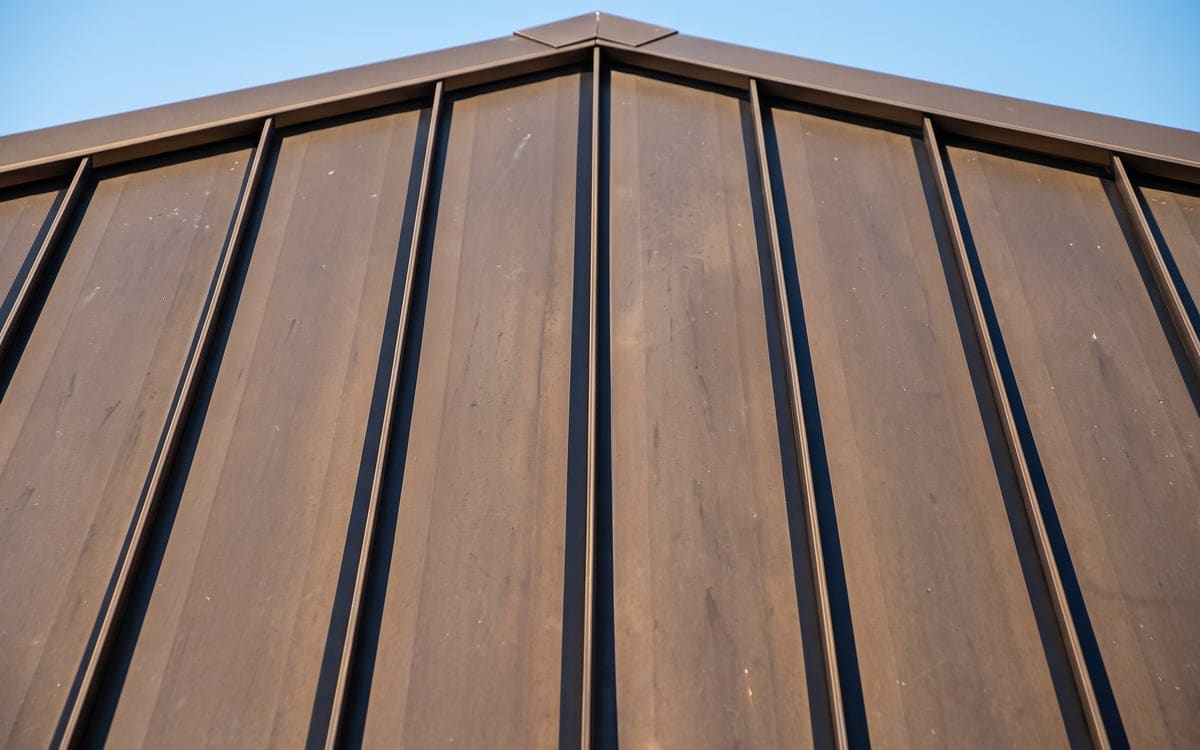
A metal roof goes on as long vertical panels. In a standing seam system, each panel's edge is bent up and folded over the neighboring panel to form a tight joint that stands above the roof surface, in the Metal Construction Association's description. In a through-fastened system, threaded fasteners with washers go through the panel and the fastener heads remain on the finished roof. The underlayment sits under both.
Hail: the labels on each
The labels on a shingle roof are set by the shingle. ARMA, the shingle makers' association, describes UL 2218 as a steel-ball drop test from 12 to 20 feet rating impact resistance from Class 1 to Class 4, with Class 4 the highest, and notes that the ability to resist impacts is of interest to many homeowners but is not required by the building codes. The wind tests are two methods: asphalt shingles are tested to ASTM D3161 (fan-induced method), where Class F is the highest rating, and ASTM D7158 (uplift method), where Class H is the highest. Since 2019 the research group IBHS has rated hail impact-resistant shingles using laboratory-made hailstones, which it says gives a more realistic measure of damage than traditional steel balls, and in 2025 none of the 24 products tested earned an Excellent rating.
Metal has its own labels. In the Metal Roofing Alliance (MRA)'s words, many metal roofing products have the highest impact resistance and hail rating granted by Underwriters' Laboratory (UL), and hail will typically not penetrate a metal roof. On wind, the association says many metal roofing systems can withstand winds in excess of 140 mph, with the key to a high-performing metal roof being proper installation and secure attachment. All of those are statements about tested or well-built systems, not about any one house. For a Bexar County hail picture, see what hail damage does to a roof; from 1996 to mid-2026 NOAA's Storm Events Database holds 363 Bexar County hail reports of 1 inch or larger, which is enough to put either roof to work.
Sun, heat and noise
San Antonio heat matters for both. San Antonio International Airport averages 122.4 days a year at 90 degrees or more, and the San Antonio station in NCEI's comparative climatic data gets 57 percent of possible sunshine for the year, up to 72 percent in July. On a metal roof the temperature that matters is the panel surface temperature, not air, with lighter colors and high-gloss finishes running cooler than dark, low-gloss ones in the MCA's manual, and cool-roof metal coatings use cool pigments in the paint to raise solar reflectance and lower the surface temperature of the roof per the MRA.
For noise, modern residential metal roofs go over solid decking such as plywood or OSB and an underlayment, which act as sound barriers, with how loud any roof sounds depending largely on attic insulation, ventilation and roof structure, and the MRA says there is little difference between metal and other materials when it comes to noise from rain or hail.
HOAs, historic districts and the look of the street
Texas Property Code 202.011 is written for shingles, not metal panels. The statute says a property owners' association cannot stop an owner (otherwise authorized to install shingles) from putting on shingles designed to be wind and hail resistant, more energy efficient, or solar-generating. The owner's shingles still have to resemble those used or authorized in the subdivision, be more durable than and of equal or superior quality to them, and match the look of surrounding property. The City notes that covenants and deed restrictions can govern building materials and may be enforceable in a court of law rather than by the City. Check your HOA's rules and your deed restrictions before you plan either material.
Texas Property Code 202.011 and HOAs
An owners' association may not bar these shingles for an owner otherwise authorized to install shingles, as long as every listed condition is met.
Shingles the law covers
- Designed to be wind and hail resistant
- Better heating and cooling efficiency than customary composite shingles
- Solar generation
Every condition
- Resemble the shingles used or allowed in the subdivision
- More durable than, and of equal or superior quality to, those shingles
- Match the look of the surrounding property
Source: Texas Property Code, Section 202.011.
Historic districts are a separate layer. In San Antonio's historic districts, metal is for a building that historically had a metal roof or where it suits the style or construction period, per the Office of Historic Preservation's chapter 2 guidelines; the same chapter also asks for replacement in kind whenever possible on sloped roofs. The Office decides each case.
How to weigh the two for your house
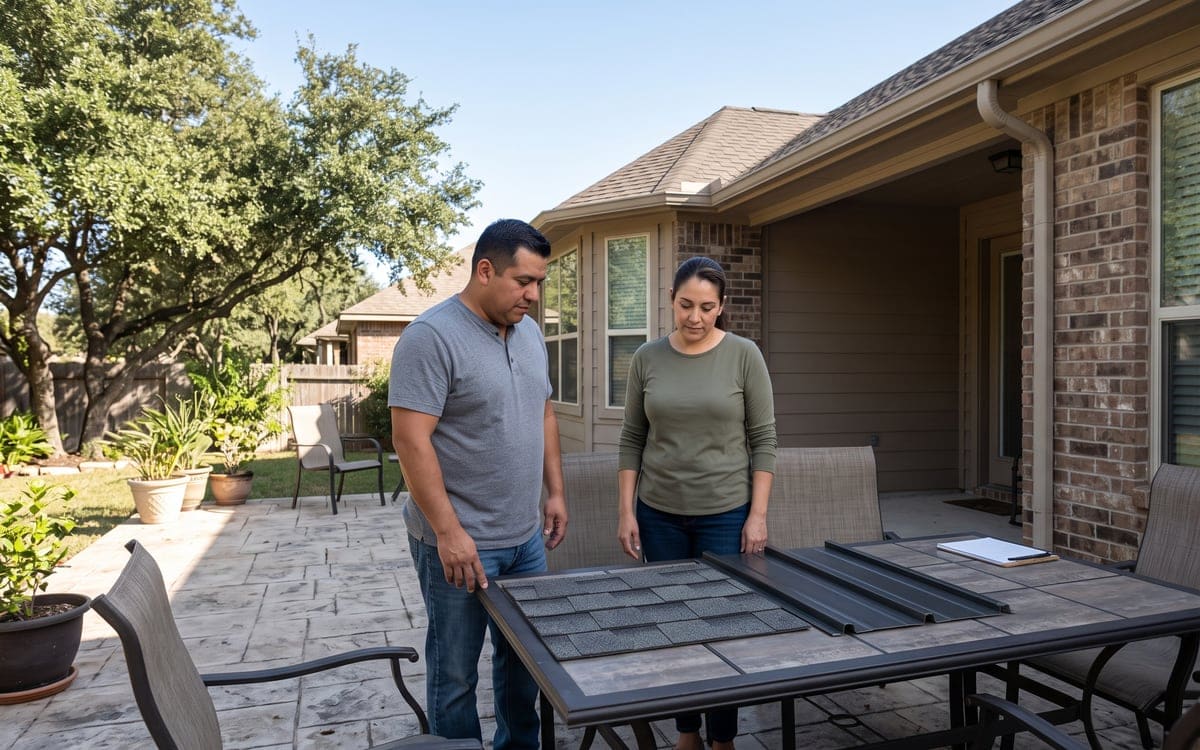
The MRA says the shape and pitch of the roof influence the installed cost of a metal roof more than the style of metal chosen, and staging area, material storage, hips and valleys also matter, and installation depends greatly on the size, pitch and complexity of the existing roof structure. On the shingle side, ARMA says shingle quantity is adjusted for trimming at valleys, roof penetrations and rake edges, and the increase varies with roof complexity.
| Question | Asphalt shingles | Metal panels |
|---|---|---|
| How it is held down | Nailed in overlapping courses, each over the nails of the one below | Clips or exposed fasteners through the panel |
| Impact test | UL 2218, Class 1 to Class 4 by dropping steel balls from 12 to 20 feet | UL impact rating on tested products; MRA says hail will typically not penetrate |
| Wind test | ASTM D3161 (Class F highest) and ASTM D7158 (Class H highest) | MRA's FEMA list: manufacturer instructions, local codes, load calculation with ASCE 7, tested systems with proper underlayment, clips and fasteners |
| Weight | MCA calls shingles heavier than metal | MCA calls metal lighter than shingles |
| HOA statute | Property Code 202.011: an owner otherwise authorized to install shingles may put on wind and hail resistant, more energy efficient, or solar shingles that resemble the subdivision's, are more durable and of equal or superior quality, and match surrounding property | Statute names shingles, not metal panels |
| Historic district | OHP decides on each case | OHP decides, with metal roofs where historic or style-appropriate |
For a next step on either path, see a repair, work after hail, replacing the whole roof, tile or metal. For the drivers behind any new roof's price, see what moves the price.