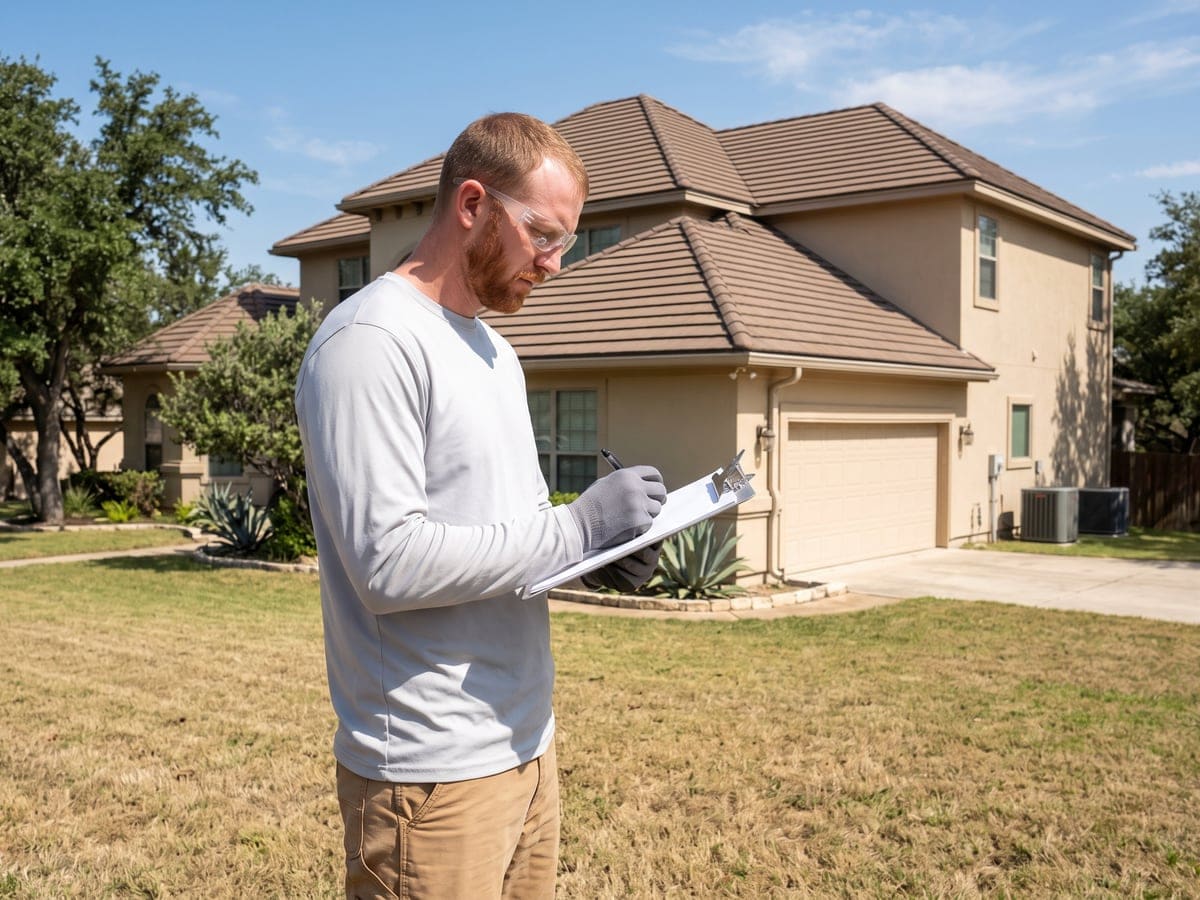
Looks that need no ladder
- From the yard: shingles lifted or missing, dents on gutters or downspouts, a ridge line that dips.
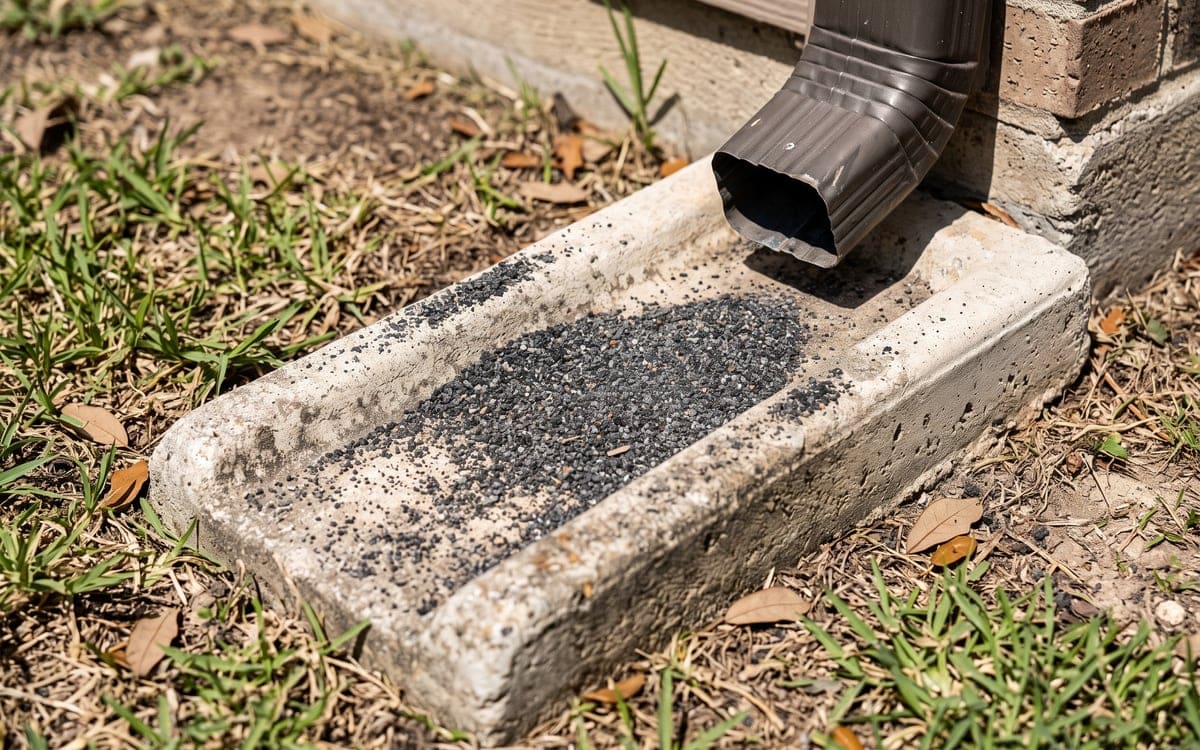
- At the splash block below a downspout: shingle granules collected in the concrete pan.
- On the ceilings and around light fixtures: tan rings or damp spots.
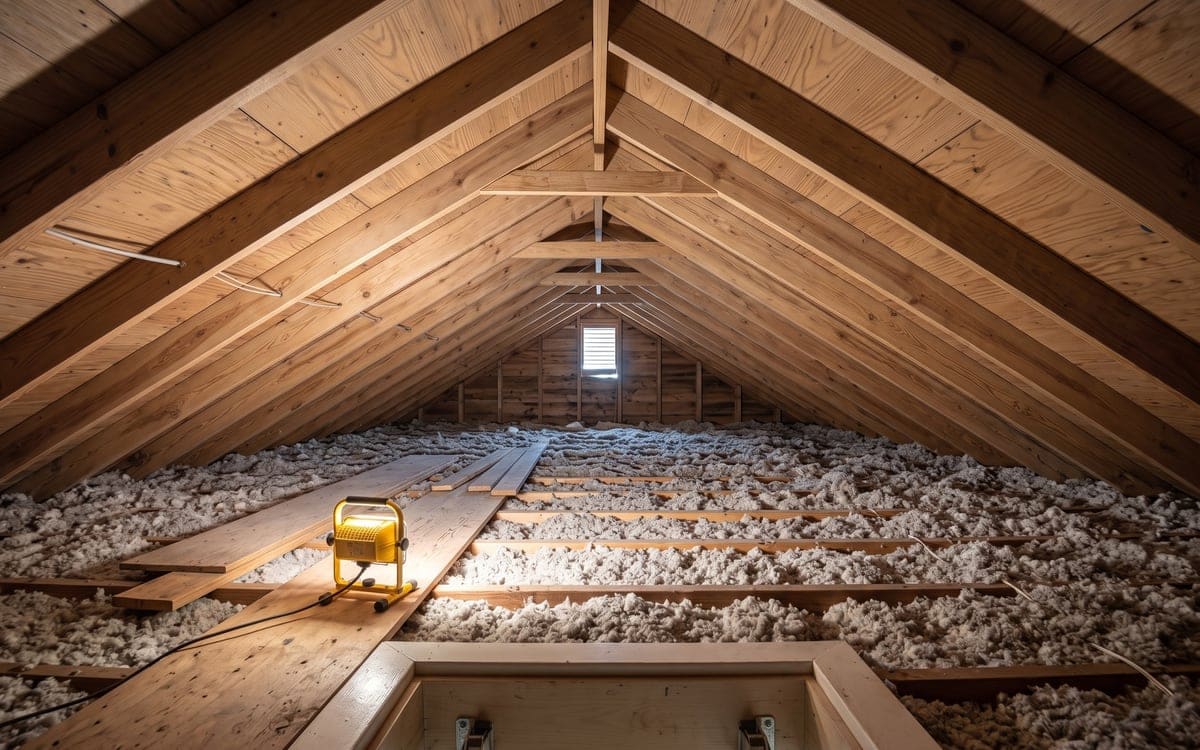
- At the attic hatch, from the opening: wet or water-stained sheathing or attic flooring.
Checks from the yard and the hallway
Looks you can take without going up. Anything on the roof itself stays with a roofer.
From the yard
Shingles lifted or missing, dents on gutters or downspouts, a ridge line that dips.
At the splash block
Shingle granules collected below a downspout.
On the ceilings
Tan rings or damp spots in any room.
At the attic hatch
Wet or water-stained decking or attic flooring, seen from the hatch opening.
These are checks a person can make without climbing. Walking on a roof should be limited to a minimum to avoid damaging the roof surface, ARMA, the shingle makers' association, writes.
The black streaks on a shingle roof are a different question. Black streaks on many roofs are often mistaken for mold or mildew but are actually algae, and there is no scientific evidence that algae damages asphalt shingles, although it certainly affects how a roof looks, ARMA writes.
When San Antonio roofs get looked at
The Bexar County rows of NOAA's Storm Events Database hold 363 hail reports of 1 inch or larger from 1996 to mid-2026, 126 of 1.75 inches or larger and 64 of 2 inches or larger, 158 of them in April, 91 in May and 61 in March. Recent counts hold 58 reports in 2016, 38 in 2021, 35 in 2023, and 26 in each of 2020, 2024 and 2025, with reporting growing over the span, and the same database holds 64 Bexar County thunderstorm wind reports of 58 mph or faster.
San Antonio has 98,896 homes built in the 1980s, 81,641 built in the 1970s and 60,358 built in the 1960s, and the median home dates from 1985, which is the age of the house, not of the roof above it. For landlords, San Antonio's Property Maintenance Code requires a roof and its flashing to be sound, tight and free of defects that admit rain, and roof drains, gutters and downspouts to be kept in good repair and free of obstructions; 66,681 renter-occupied homes in San Antonio are detached houses. The Historic Design Guidelines add that a weather-tight roof is essential to preserving any structure.
What our roofer looks at, edge to ridge
The covering
Shingles are read for lifted and creased tabs, torn shingles and granule loss on every slope. IBHS writes that dents and tears can let water through a shingle, and lost granules expose the asphalt to ultraviolet light, which breaks it down and makes it more brittle over time. Metal panels are read for dents and loose fasteners. Tile gets a careful eye.
Flashing and valleys
Flashing is the metal where the covering stops: against a side wall, around a chimney, at the eaves and rakes under a drip edge, and down a valley where two slopes meet. Roof-to-wall intersections are among the most vulnerable areas of a house, because if they are not flashed properly, water works into the wall and often goes unnoticed until extensive damage results, the shingle manufacturer GAF writes. Step flashing against walls, counterflashing at the chimney, and the drip edge at the eaves and rakes get a close look.
Vents, boots and the ridge
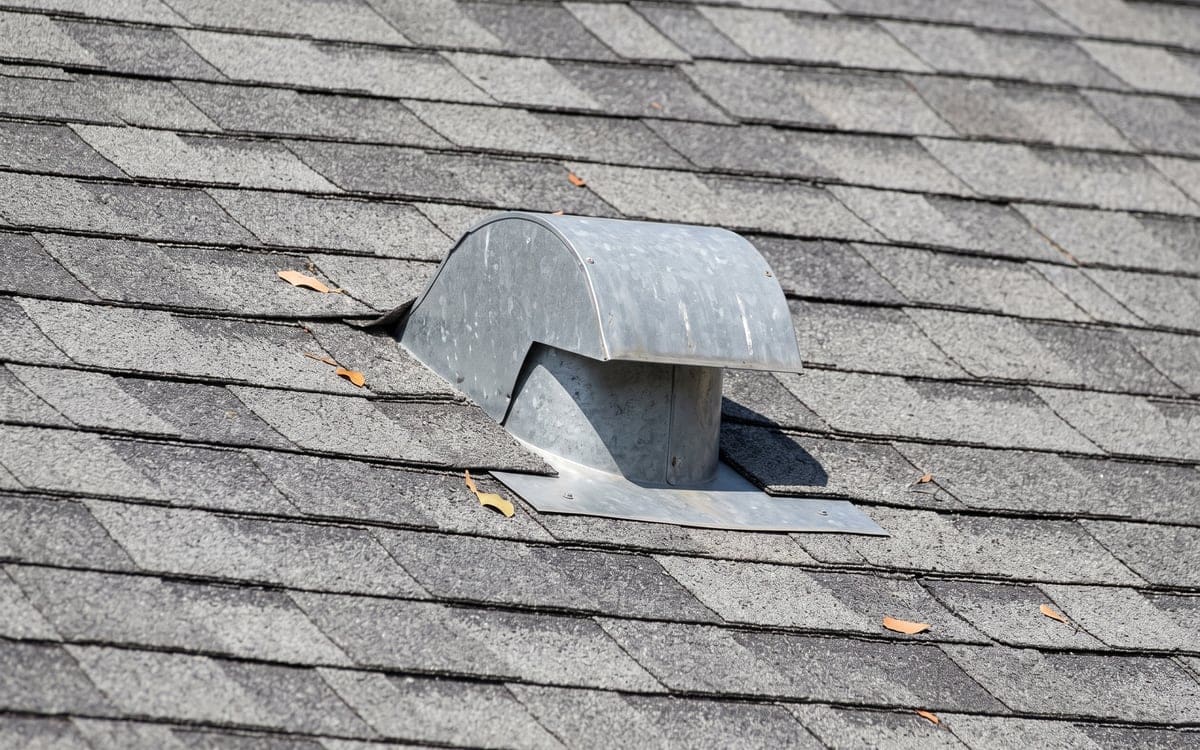
Each roof penetration is a seam. The preformed flange (boot) around a vent pipe should be inspected once a year for cracks, ARMA's manual says. Some vent pipes are sealed with a rubberized gasket, and over time the gasket or its sealant can dry out and fall apart, Owens Corning adds.
Gutters and what collects in them
Owens Corning writes that tree branches rubbing against shingles, especially in windstorms, can disturb the roof granules, and that a downspout that empties onto a lower roof sends runoff over the same section every time it rains, which can dislodge granules and cause algae stains.
The attic and the deck
From the hatch opening, a roofer reads the underside of the deck for marks of past leaks. The underside of the roof deck can be inspected from the attic to detect leaks, and where a problem shows, a competent roofer should make an on-roof inspection, ARMA says, and that penetrations and intersections are typically the places most vulnerable to water getting in, and signs of leakage there include wet or water-stained roof decking or attic flooring.
| What you notice | What our roofer checks | Work it can lead to |
|---|---|---|
| Granules at the splash block | The slopes above for granule loss and exposed asphalt | A spot repair or a replacement when wear is across the roof |
| Dents on a gutter after hail | The shingles and metal caps on the same slopes | Shingle repair up to a replacement |
| A tan ring on a ceiling | The flashings and the deck from the hatch | A leak repair at the flashing, boot or valley the water came in through |
| Black streaks on a shingle slope | Confirmation that the streak is algae | ARMA says there is no scientific evidence it damages asphalt shingles |
| A ridge line that dips | The ridge beam, trusses and sheathing | A structural look before any roof work goes further |
| An older roof with nothing dripping | Fasteners, flashings and the deck for small defects a reader cannot see | A repair in one place, or no work on its own |
An inspection, a repair, or more
A repair in one area covers worn flashing, a boot on one pipe, or lifted shingles. A leak at a flashing, a valley or a boot is its own page. Hail or wind damage is a storm job. A replacement is a whole new roof. For tile, Eagle, a tile maker, says walking on a tile roof can break tiles and put the walker at risk; a tile roof look stays with a roofer who works on tile.